
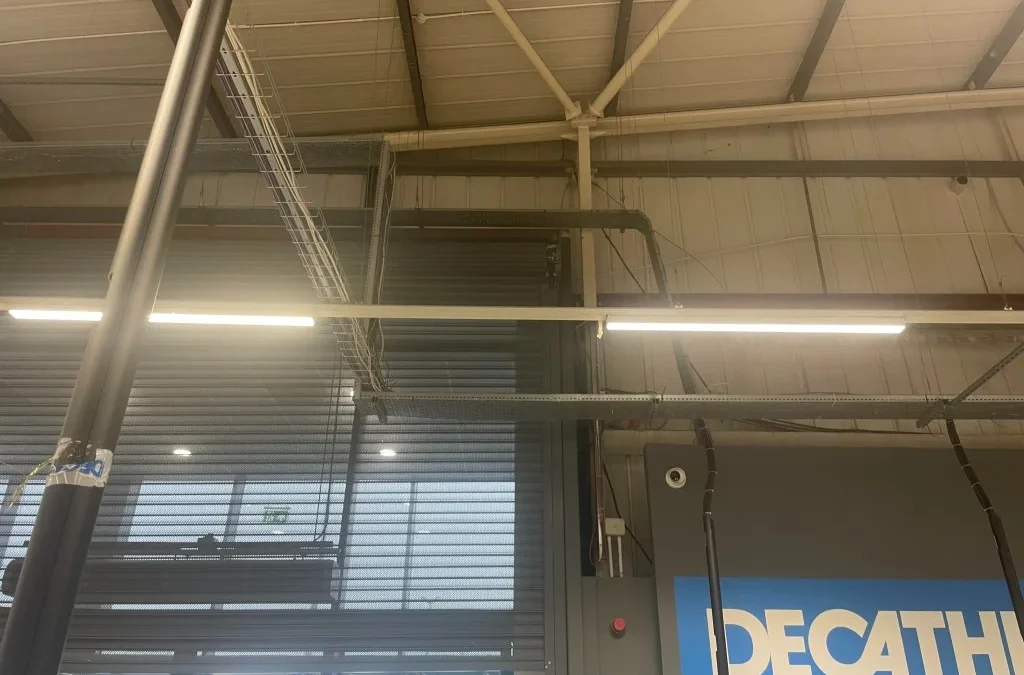
You survey it while the store is open, settle the sequence on paper, and do the physical work in the hours the shop is shut. That is how the tray blocking the exit shutter at Decathlon Stockport was moved: planned in advance, started on a Sunday night after closing, finished by midnight, with the store trading as normal the next morning.
The job came out of a failure nobody had scheduled. One morning the store manager raised the entrance shutter without trouble, moved on to the exit shutter, and it stopped halfway. Door engineers traced the fault to the motor inside the barrel, which meant the barrel had to come out. On the way sat a large cable tray.
Why Does the Cable Tray End Up in the Way?
The tray was there first
In a large retail unit, the cable tray goes in early. It carries the bundles feeding lighting, tills, data and signage across the ceiling, routed along the cleanest line available at fit-out, which is often straight across the front of the building. Shutters, barrel housings and air conditioning arrive afterwards and get fitted around it.
Nobody plans for the shutter to fail
Years later the tray has usually been added to rather than redesigned, and it is now full. When a shutter motor goes and the barrel has to come out, the tray that was installed first turns out to sit directly across the only access route. Nothing is wrong with the tray. It is simply in the wrong place for the one job that needs doing, and it cannot be cut, dropped or shoved aside with the store open underneath it.
The Planning Is the Part That Happens in Trading Hours
A zero-closure job is won or lost before anyone turns up with tools, and the survey can be done while the shop is open.
What does the survey have to establish?
- What the tray actually carries, and which of those circuits can be left live while it moves.
- Where the tray can be broken, where it needs new support, and what it is fixed back to.
- Whether a scissor lift fits through the doors, down the aisle and under the ceiling height at the work position.
- What is stored or displayed underneath, and who moves it.
- Who else needs to be on site that night, and in what order they work.
Sequencing it on paper
The last point decides the night. On the Decathlon job the electrical work was not the end of the job, it was the thing standing between the door engineers and a broken motor. The tray had to come clear first, the shutter team had to follow straight behind, and both had to be finished inside the same closed window. A sequence that works only if nothing goes slightly wrong is not a plan.
Doing the Work in the Hours the Shop Is Shut
● Sunday night buys you the longest window
Retail hours make the decision for you. A Sunday close gives the longest clear run before the doors open again, and it is the one night of the week where an overrun does not immediately eat into a full trading day. That is the window the tray reroute used: the team went in after the store closed on Sunday, worked through, and were finished by midnight.
● The access platform does the heavy lifting
The tray sat high, so the work ran off a powered access platform rather than towers or ladders. A scissor lift gets two engineers and their fixings to the right height and moves along the run as the work progresses. It also has to be driven through a shop floor without marking it, which is why the route gets agreed at survey rather than at eleven at night.
The tray was unbolted, supported and moved clear in sections, and the roller shutter engineers took over from there to replace the motor inside the barrel.
Leaving the Shop Floor Fit to Trade
The measure of an overnight job is what the morning staff walk into. Fixtures and stock under the work area get moved or sheeted first, because swarf, old fixings and dust land somewhere.
Everything that comes off the tray run leaves with the team. Nothing stays propped against a wall for the next visit, and the lift goes out the way it came in. Anything unfinished has to be left in a state the store can trade around, which is a different standard from merely safe.
For a store manager, that is the actual test. The shutter works, the ceiling looks as it did, and nobody opening up has to explain anything to a customer.
The Electrical Side of Moving a Loaded Tray
● Moving cable is not the same as moving tray
A tray full of live circuits has a bend radius, a weight and terminations at each end that were never meant to travel. Some circuits can be slackened and repositioned. Others have to be isolated, and a few need extending rather than persuading. Deciding which is which is the electrical judgement in the job, and getting it wrong shows up as a dead till lane the next morning rather than as a bang on the night.
● Working at height is a qualification of its own
The platform matters as much as the wiring. Expert Spark engineers are IPAF trained and qualified for powered access platforms, so the lift is run by the people doing the electrical work rather than by a hired operator with a separate set of assumptions.
What to Ask Before Anyone Quotes a Live-Store Job ?
Five questions separate a contractor who has done this from one who is about to find out.
- When do you survey, and does it cost me trading time? The answer should be during opening hours, and no.
- Who operates the access platform? If the lift comes with a hired operator who is not part of the electrical team, that is two sets of instructions on one job.
- What happens if it overruns? You want to hear what gets left safe and tradeable, not a promise that it never happens.
- Who talks to the other trades? On a shutter job the electrical work only buys access for someone else, and the handover between the two is where nights get lost.
- What does finished mean? Finished is the store opening normally, not the tray being off the shutter.
The Decathlon job ran on one plan with one point of contact. Expert Spark worked out the sequence in advance, brought the platform and the qualified operators, cleared the tray on Sunday night, and handed it straight over to the shutter engineers.
Frequently Asked Questions
1. How long does a cable tray reroute take in a live store?
It depends on the length of the run and what the tray carries, but the Decathlon reroute was done inside one night, from the store close to midnight. The survey and the planning happened well before that, which is what kept the night itself short.
2. Does the store have to close?
No, if the work is scheduled into hours the store is already shut. Closing only becomes necessary when the job is booked at short notice with no survey behind it and the sequence has to be worked out on the floor.
3. Do the circuits have to be switched off?
Some of them, for part of the time. Which circuits and for how long is decided at survey stage, and it is worth knowing in advance whether that touches tills, chillers or security before the night arrives.
4. Why not just cut the tray out of the way?
Because it is holding live services that the store needs the next morning. Tray gets unbolted, supported and repositioned so the cables stay intact and the run can be fixed back properly.
5. Who is responsible if two trades are on site at once?
Somebody has to own the running order, and it is better agreed in the quote than argued at eleven at night. On the Decathlon job the electrical work cleared access and the shutter engineers followed behind in the same window.
6. Is working at height on a shop floor treated differently?
The access equipment and the qualifications are the same, but the floor beneath is not. A retail ceiling sits above stock, glazing and flooring that all mark easily, so the lift route and the drop zone are planned rather than improvised.
Recent Comments