
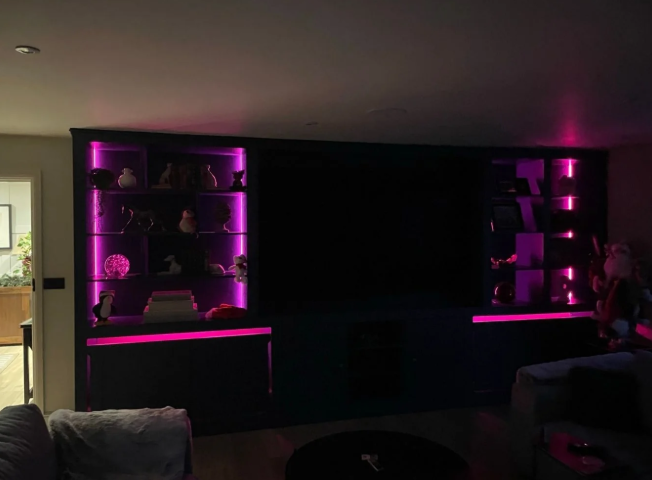
For one room done properly, most Manchester homeowners are looking at a few hundred pounds at the smart-switch end and well into four figures once hidden LED runs, separate zones and a control system are involved. The spread is wide because a mood lighting installation is not one product with a price on it. It is a number of zones, each needing its own cable, driver and control channel, installed into a room that is either open or already finished.
That is why two quotes for the same room can differ by a factor of three and both be honest. The number that matters is not the price per fitting, it is how many separately controlled zones you are asking for and whether the walls are open when the electrician arrives.
The Four Things You Are Actually Paying For
Break any quote into these four and it stops looking arbitrary.
● The fittings
Downlights, LED strip, profiles, pendants, uplights. This is the part people price up online and it is usually the smallest line in the quote. Decent dimmable strip and an aluminium profile to run it in is not expensive. A cheap strip is a false economy, because it shows colour variation along the run and fades unevenly, and replacing it means opening up the detail you just paid to have plastered.
● The control gear
Drivers, dimming modules, scene controllers, wall plates. Every zone needs a channel, and channels cost money whether they are separate dimmer modules in the consumer unit or a multi-channel controller. This is where the quote climbs with zone count, and it is the line most people have not budgeted for.
● The labour
Pulling cable, forming the detail, fixing the fittings, terminating, commissioning. On a finished room, labour includes lifting and relaying floors or chasing and patching walls, and that often outweighs everything else in the quote.
● Making good
Plastering, filling, painting. Some electricians include it, some leave it to your decorator, and a quote that is silent on it is not comparable with one that covers it. Ask directly.
● Rough Brackets, Smallest to Largest
These are the brackets the work tends to fall into rather than anybody's price list, and the only figure that counts is the one on your own written quote.
- Smart lamps and a smart switch in an existing room. Low hundreds. No cable, no plastering, and you get scene control and colour temperature in fittings you already have. The ceiling is still the only place the light comes from.
- One new zone in a finished room, surface mounted. Mid hundreds. A perimeter profile or an under-cabinet run, fed from an existing circuit, with the cable routed rather than buried.
- Two or three zones in a room being renovated. Four figures. Downlights, a hidden cove run and a pendant on separate channels, wired at first fix while the walls are open.
- A full ground floor with a control system. Several thousand. Multiple rooms, multiple zones each, tunable white throughout, wall plates and app control, commissioned as a set of scenes.
The gap between the second and third brackets is the one worth understanding. It is not about better fittings. It is that a second and third zone each need their own supply and their own control channel, and that is the cost.
What Pushes the Price Up ?
● Zone count, ahead of everything else
Each zone is a cable run, a driver or a channel, and a control decision. Going from two zones to five roughly doubles the control gear and adds most of a day of labour. If one number explains the difference between two quotes, it is usually this one.
● Working in a finished room
An open wall is cheap to wire. A plastered one is not. Lifting a floor to drop a cable, chasing a channel for a back box, then patching and repainting can cost more than the lighting itself. The same specification in a room stripped back for renovation and in a room decorated last year are two different jobs at two different prices.
● Colour instead of tunable white
A full RGBW strip needs more channels, more expensive drivers and more commissioning time than tunable white, which only shifts between warm and cool. Most households end up living in warm white and touching colour twice a year, so this is often money spent on a feature that goes unused.
Hidden detail rather than surface fittings
A cove, a shadow gap or a recessed skirting detail is carpentry and plastering before it is electrical work. It looks far better, and it is the single biggest step up in cost compared with a surface-mounted profile doing a similar job.
● Ceiling height and access
High ceilings, stairwells and galleried landings need access equipment and two people where a standard room needs neither. It is a straightforward addition to the labour line, and it is worth knowing about before the quote lands.
Where the control system sits
Standalone smart switches are the cheap end. A wired, centralised system with everything in the consumer unit and proper wall plates costs more up front, keeps working if the internet drops, and is what larger installations use. The tier you pick changes the quote considerably.
What Keeps It Down?
Timing is the big one. Wiring lighting zones while a room is already stripped back costs a fraction of doing it afterwards, because the expensive parts of the job, the opening up and the making good, are already happening for other reasons. If a kitchen or an extension is going in, the lighting conversation belongs in that programme rather than a year later.
Fewer zones done properly beats more zones done thinly. Two well-placed layers, a dimmed ceiling and a warm perimeter run, will change a room more than five zones of mediocre strip. Spend the budget on the layers that do the work.
Surface-mounted profiles are the honest compromise in a finished room. A slim aluminium channel on the wall or ceiling gives you the second layer without the plastering bill, and reads as a deliberate detail rather than a cost saving.
First-fix cabling now, fittings later, also works. Pulling the cables for five zones while the walls are open and only commissioning two of them leaves the other three waiting behind a blanking plate, with the costly part already done.
Tunable white over full colour saves money on drivers, channels and commissioning, and most people never miss the colour.
Why Two Quotes Can Differ by Thousands?
They are usually quoting different jobs
One quote has three zones, surface profiles and no making good. The other has five zones, a plastered cove detail, a wired control system and decoration included. Neither is wrong. They are answers to different questions, and nobody compared them because the question was never written down.
Five things to pin down before you ask for prices
- The zone list. Name each zone and which fittings are in it.
- White or colour. Tunable white or full RGBW, stated per zone.
- Hidden or surface. Whether each run is built into a detail or mounted on it.
- Making good. Plastering and decorating in or out, and to what standard.
- Commissioning. Who sets up the scenes, and whether that visit is in the price.
Send the same five answers to everyone quoting and the prices become comparable. Without that list you are collecting numbers for jobs that nobody has specified.
Getting a Number That Means Something
Nobody can price this over the phone, and an estimate given without seeing the room is a figure that will move later. What you want is a site visit, a zone plan agreed in writing, and a fixed price against that plan.
Expert Spark has delivered this as a project in its own right, running energy-efficient LED mood lighting with smart dimming and colour control, keeping the cabling discreet and matching the design to the interior. Quotes across its domestic work are free and carry no obligation, the price quoted is the price paid with no end-of-project surprises, and there is a match on like-for-like work and materials from another local Manchester electrician.
Worth asking at the visit: which zones the electrician would actually recommend rather than which ones you asked for. A good answer often removes a zone and improves the room.
Frequently Asked Questions
1. Is mood lighting cheaper if I buy the fittings myself?
It can shave a little off, and it moves the warranty problem onto you. If a driver fails in year two, an electrician who supplied it sorts it out, and one who fitted your parts will charge to come back. Ask before you order anything.
2. Does the number of rooms or the number of zones matter more?
Zones. Three rooms with one zone each is a simpler and cheaper job than one room with six zones, because the cost sits in cable runs and control channels rather than in doorways.
3. Can I add zones later?
Only as far as the cabling allows. Zones that were wired at first fix can be brought into use cheaply, and zones that were never cabled mean opening up the room again. This is the decision worth getting right before the plasterer arrives.
4. Will mood lighting put my electricity bill up?
LED lighting on dimmed scenes usually draws less than the downlights it replaces, so the running cost tends to fall rather than rise. The installation is the cost, not the electricity.
5. Is it worth it if we might move in a few years?
Treat it as something you are buying for yourself to live with rather than an investment with a return. A well-executed installation does add to how the property shows, but nobody should count on recovering the spend at sale.
6. How long does the work take?
It depends entirely on the zone count and whether the room is open, so any duration quoted before a site visit is guesswork. Ask for the stage breakdown instead, because first fix, plastering and second fix is what you will be living around.
Recent Comments